


Most of the time, gift tax feels theoretical.
With the basic exclusion amount at $13.99m for 2025, almost no clients will ever write an actual check to the IRS for gift tax.
For most returns, the workflow is simple: file Form 709, burn some exemption, move on.
Once you start working with ultra–high-net-worth clients, that simplicity often breaks down.
I recently worked with a baller ophthalmologist whose net worth exceeded $100 million. Over his lifetime, he expects to transfer more than $50 million using a mix of spousal lifetime access trusts (SLATs), dynasty trusts, outright gifts, and significant charitable giving.
For clients like him, “no gift tax due” is not something you assume.
It’s something you must prove— by doing the math correctly under IRC §2502.
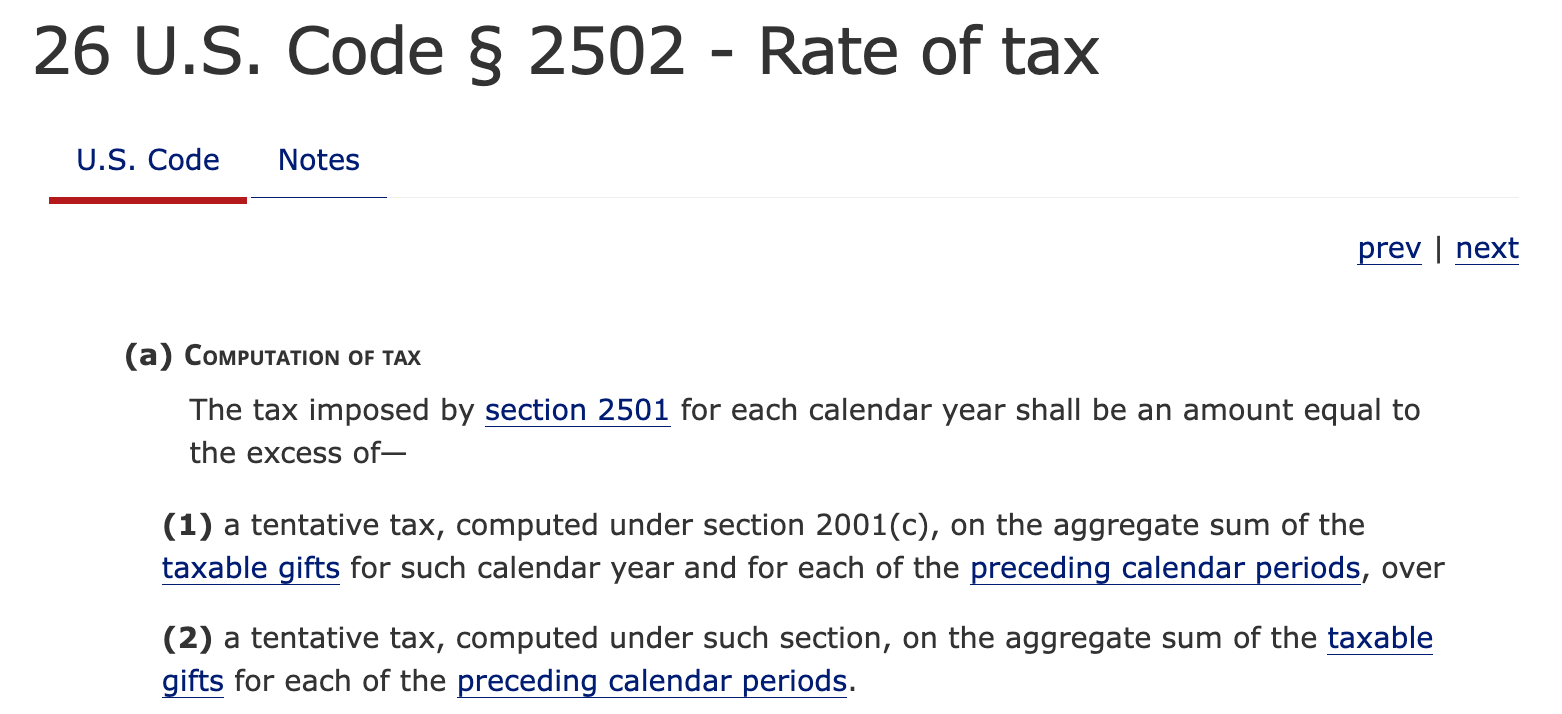
Below is a clean, repeatable framework you can use to calculate gift tax properly, even when the final answer is zero.
Example: The Grinch-Taxtor Becomes a Philanthropist (2025)
Assume the following:
Taxtor makes three gifts in the same year:
$10,000,000 cash to his spouse
$10,000,000 cash to the Red Cross
$10,000,000 cash to Kanye
Taxtor has never made any prior taxable gifts.

Step 1: Add Up All Gifts
Start with the total value of all transfers made during the year.
$10,000,000 to spouse
$10,000,000 to charity
$10,000,000 to Kanye
Total gifts: $30,000,000
Step 2: Apply the Annual Exclusion Under §2503(b)
Each transfer is a gift of a present interest, so each qualifies for the annual exclusion.
Annual exclusion for 2025: $19,000 per donee
Three donees × $19,000 = $57,000
$30,000,000 − $57,000 = $29,943,000
This is your starting point before deductions.
Step 3: Apply the Marital Deduction Under §2523 (Coordinated by §2524)
The spousal gift qualifies for the marital deduction (assuming a U.S. citizen spouse). However, you don’t get a double benefits for the same dollars. §2524 coordinates the rules and prevents applying both the annual exclusion and the marital deduction to the same portion of a gift.
Spousal gift: $10,000,000
Less annual exclusion: $19,000
Allowable marital deduction: $9,981,000
Applying the marital deduction to the taxable gift calculated thus far:
$29,943,000 − $9,981,000 = $19,962,000
Step 4: Apply the Charitable Deduction Under §2522 (Also Coordinated with §2524)
The same coordination logic applies to charitable gifts.
Charitable gift: $10,000,000
Less annual exclusion: $19,000
Allowable charitable deduction: $9,981,000
Applying the charitable deduction:
$19,962,000 − $9,981,000 = $9,981,000
This amount is the taxable gift for the year.
Step 5: Add Prior Taxable Gifts
Taxtor has no prior taxable gifts.
Cumulative taxable gifts: $9,981,000
Step 6: Compute the Tentative Tax Under §2502
Next, compute gift tax on cumulative taxable gifts using the unified rate schedule.
Tax on first $1,000,000 (graduated): $345,800
Tax on remaining $8,981,000 at 40%: $3,592,400
Tentative tax:
$345,800 + $3,592,400 = $3,938,200
This is the tentative gift tax before applying the unified credits under §2505.
Step 7: Subtract Gift Tax Paid on Prior Gifts
There are no prior gifts and therefore no prior gift tax paid.
Tentative tax remains: $3,938,200
Step 8: Apply the Unified Credit
The unified credit is the saving grace Congress gave us. It can be used to offset gift tax liability dollar-for-dollar
Unified Credit for 2025: $5,541,800
Gift tax liability:
$3,938,200 − $5,541,800 = $0
Final Result
Even though Taxtor transferred $30 million in a single year:
Annual exclusions reduced the starting amount
The marital deduction eliminated the spousal gift
The charitable deduction eliminated the charitable gift
Only $9.981 million was taxable
The unified credit fully offset the tentative tax
Final gift tax due: $0
Why This Matters for Tax Pros
When a big-shot clients make multiple gifts across different categories in the same year, you cannot shortcut the analysis by saying “it’s under the exemption.”
The statute requires you to:
Determine taxable gifts
Apply deductions in the correct order
Compute tentative tax under §2502
Account for prior gifts
Then apply the unified credit
Once a client has prior taxable gifts, this same framework still applies. You simply plug the cumulative numbers into Steps 5 and 7.
and one final reminder: When you do this time-consuming math - make sure you charge for your time and expertise!
Tax Pros:
Have you dealt with a complicated gift-tax situation that required you to use this framework? If so, let’s share notes and learn from each other.