


Politics aside, every physician should understand, and take advantage of, the tax opportunities Congress creates.
I’ll admit it.
I wish they had picked a different name.
Maybe “Minor Restrictive IRA Account” would have been more descriptive, and a lot less politically charged.
But whether you love it, hate it, or couldn’t care less about politics, the Trump Account (IRC §530A) is worth understanding.
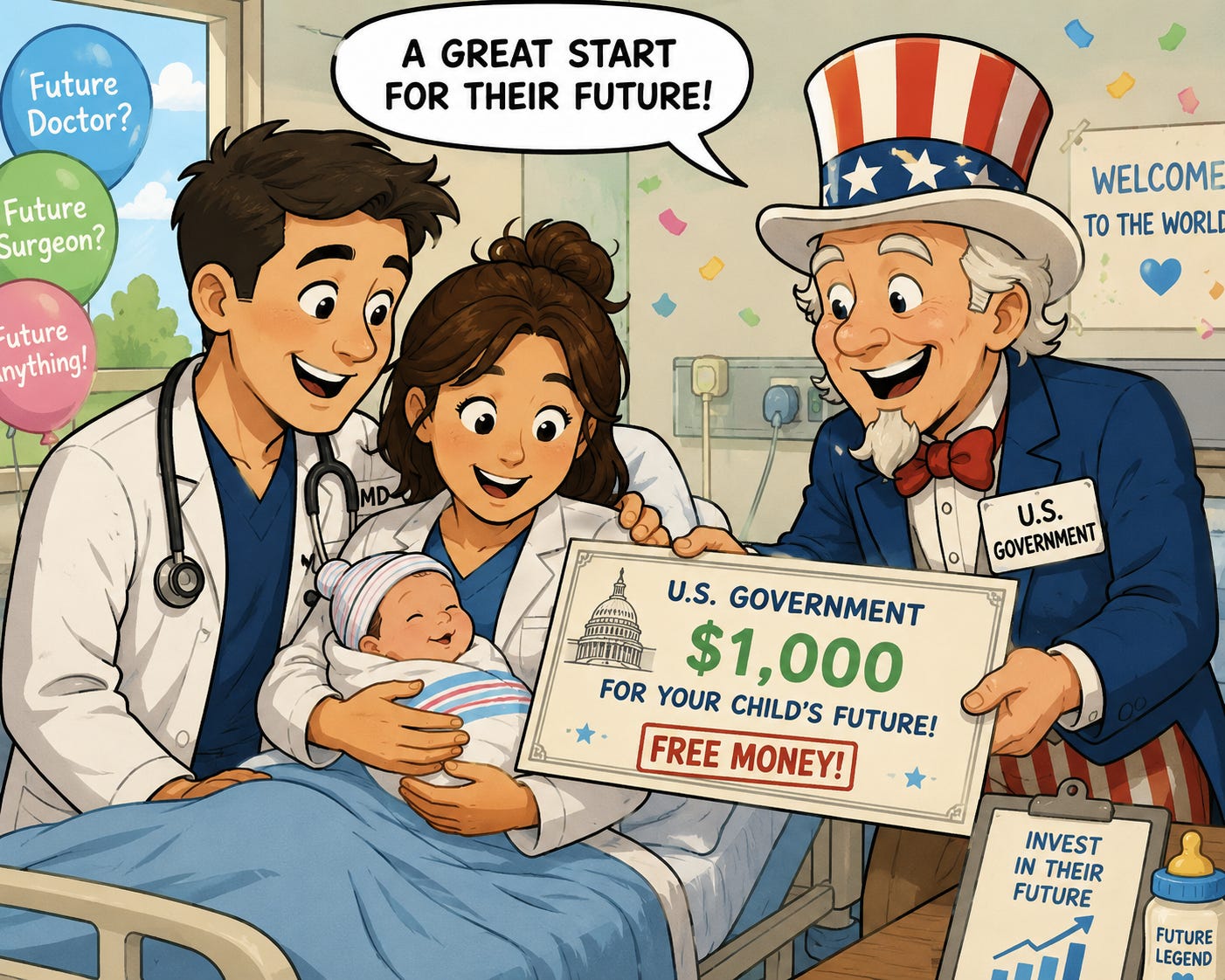
For some physician families, it could mean $1,000 of free money from the government.
And who doesn’t like free money?
For my own family, though, I’m passing for now.
Here’s why.
What Is a Trump Account?
Think of it as a long-term investment account for kids.
If a traditional IRA and a custodial investment account had a baby, this would probably be it.
Parents, grandparents, relatives and even employers can contribute.
The catch?
The money is essentially locked up until the child turns 18.
In general, you can’t simply dip into it whenever your daughter decides she wants an extravagant quinceañera... or your son suddenly "needs" a Tesla.
It’s designed to encourage long-term investing, not become another flexible savings account.
Tax-wise, it behaves more like a traditional IRA than a Roth IRA.
You contribute after-tax dollars, but once the child reaches adulthood, the account generally follows traditional IRA-style tax rules. In other words, the investment growth is generally taxable when it’s eventually distributed.
The Best Part: $1,000 of Free Money
Here’s what got everyone’s attention.
If your child is a U.S. citizen born between January 1, 2025, and December 31, 2028, the federal government may deposit $1,000 into the account through a pilot program, assuming the eligibility requirements are met.
That’s a pretty nice welcome-to-the-world gift.
If you’re expecting a baby during that window, this is something I’d definitely learn more about.
How Much Can You Contribute?
Parents, grandparents, relatives, and others can all contribute.
During the child’s growth period, total private contributions (excluding certain rollovers and the government’s $1000 pilot contribution) are generally limited to $5,000 per year (indexed for inflation after 2027).
The money goes in after tax, creating tax basis.
Translation?
You’ve already paid tax on that money.
So when you eventually withdraw your original contributions, that portion generally isn’t taxed again.
The government’s $1,000 contribution is different: it does not create tax basis.
That means this portion may eventually be taxable when distributed.
The Employer Benefit Most Physicians Haven’t Heard About
Here’s the part that surprised me.
Your employer may be able to contribute too.
A qualified employer contribution program can contribute up to $2,500 per employee each year (not per child).
Those contributions are generally excluded from your taxable income.
Sounds like free money.
But there’s a catch.
Employer contributions count toward the child’s overall $5,000 annual contribution limit.
So if your employer contributes $2,500, your family can generally contribute only another $2,500 that year.
Also, employers don’t automatically get to offer this benefit.
They must establish a qualified written program that satisfies IRS requirements.
Personally, I haven’t heard of a single hospital offering this benefit yet.
If yours does, I’d genuinely love to hear about it in the comments.
What’s the Catch?
Like every tax strategy, there are tradeoffs.
1. Limited Liquidity
This isn’t money your child can pull out whenever they decide they want a car... or an extravagant quinceañera.
The account is designed for long-term investing, so distributions during the growth period are generally very limited.
2. Limited Investment Choices
The investment menu is intentionally boring.
Honestly, that’s probably a good thing.
Think diversified, low-cost index funds instead of trying to pick the next Nvidia.
Why This Could Become Interesting Later
The real magic isn’t an upfront tax deduction.
It’s time.
The earlier you start, the longer compounding has to work.
Once the child reaches adulthood, the account generally follows traditional IRA-style tax rules.
And here’s where tax planning gets interesting.
If your child has very little taxable income in early adulthood, there may be an opportunity to convert some or all of the account into a Roth IRA while paying relatively little tax.
That could create decades of future tax-free growth.
That’s the part I’ll be watching closely.
Why I’m Personally Passing
For my family, the opportunity cost matters.
My twins are seven.
They don’t qualify for the government’s $1,000 contribution.
Without that free money, I don’t think this is my family’s highest-priority account.
I’d rather maximize their 529 plans and, once they’re legitimately working in my tax business, begin funding their Roth IRAs.
Could I open a Trump Account?
Absolutely.
Do I think it’s the best use of my next investment dollar?
Not for my family.
The Bottom Line
The Trump Account isn’t a home run for every physician family.
But if you have a child born during the pilot program, especially one eligible for the $1,000 government contribution, I’d have a hard time arguing against opening one.
After all, who turns down free money?
One lesson I’ve learned after spending years studying the tax code is this:
The biggest tax savings usually don’t come from finding clever loopholes.
They come from simply knowing the rules before everyone else does.
📅 Are you a physician looking for legitimate ways to reduce taxes and build long-term wealth?
Book a free consult:
Disclaimer
This article is for educational purposes only and should not be construed as legal or tax advice. Individual circumstances vary, and future Treasury and IRS guidance may further clarify implementation of the Trump Account.