

Can You Go to Hawaii, Watch CME, and Deduct the Trip?
Why the tax code usually says: nice try.

Doctors have been asking this question for decades:
“I love Hawaii. Can I just go there, watch some on-demand CME, and write off the trip as a business expense?”
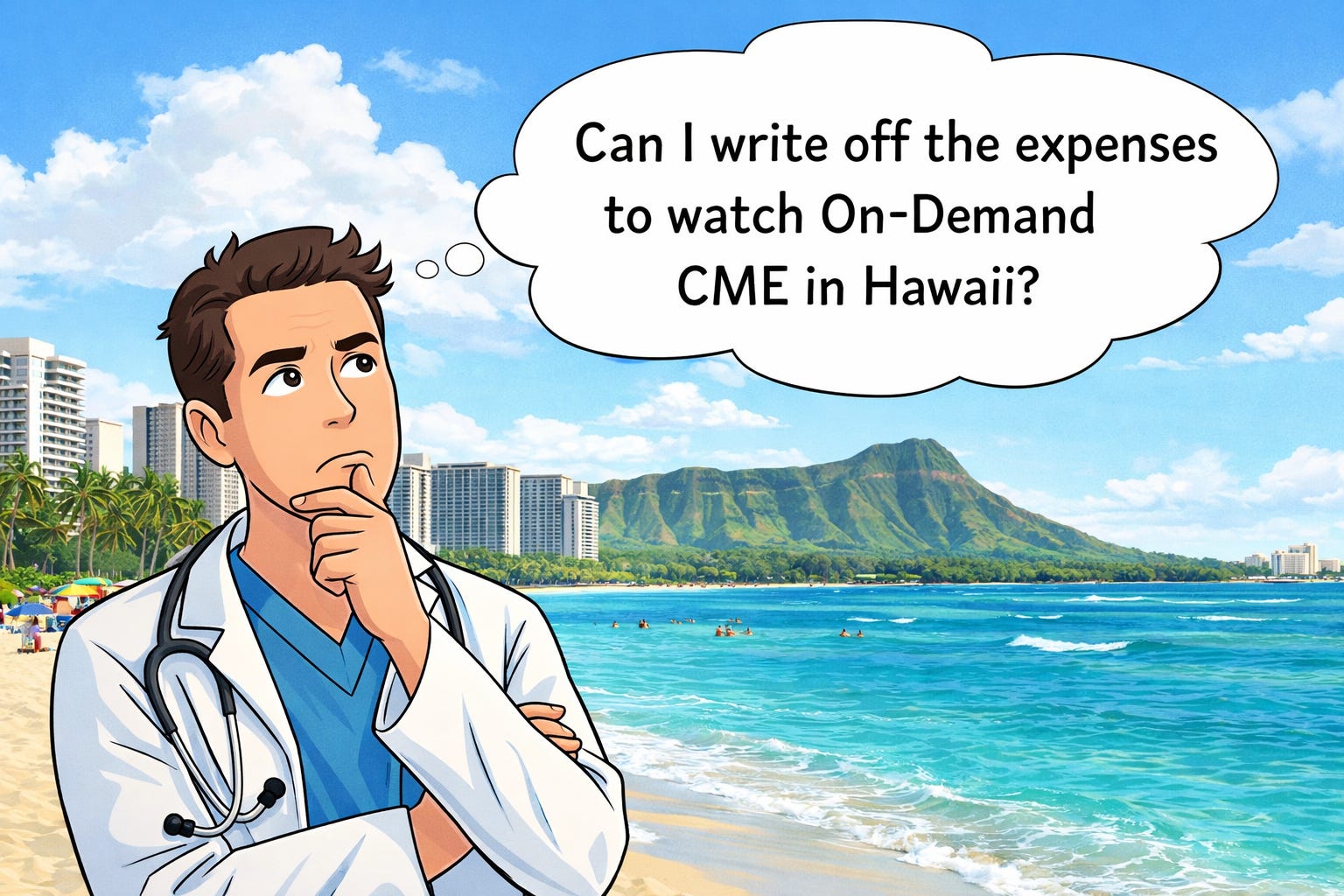
At first glance, it sounds like a brilliant idea.
Unfortunately, the tax law usually does not allow this. Watching CME from Waikiki Beach does not, by itself, turn your vacation into a deductible business trip under the tax rules for travel expenses.
But this scenario is actually a great way to understand one of the most important tax concepts for physicians who run their own practice: Internal Revenue Code §162.

The Backbone of Business Deductions: IRC §162
IRC §162(a) is the core rule that determines whether a business expense is deductible.
It allows a deduction for:
“all the ordinary and necessary expenses paid or incurred during the taxable year in carrying on any trade or business.”
Travel expenses “while away from home in the pursuit of a trade or business” are specifically mentioned in IRC §162(a)(2).
So when we analyze whether a trip is deductible, we need to look closely at two key concepts embedded in this rule:
Ordinary
Necessary
What Does “Ordinary” Mean?
The Internal Revenue Code does not define the word ordinary, so the courts stepped in to explain it.
An ordinary expense is one that is normal, usual, or customary in the type of business involved. This principle was explained in the Supreme Court case, Deputy v. Du Pont, 308 US.
In plain English, an ordinary expense is one that is common and accepted in your profession.
For doctors, travel often falls into this category. Doctors routinely travel to:
medical conferences
training courses
professional meetings
networking events
So travel itself is usually not the problem when it comes to deductibility. It is generally easy to argue that travel is ordinary in the medical profession.
What Does “Necessary” Mean?
The word necessary is also not defined directly in the Code. Courts have interpreted it to mean that an expense must be appropriate and helpful to the business, most notably in the Supreme Court case, Welch v. Helvering, 290 U.S 111. It does not have to be absolutely essential or indispensable.
Continuing medical education clearly helps physicians maintain and improve their professional skills. For an actively practicing doctor, CME that maintains existing skills is typically a necessary business expense.
So far, so good.
Travel is often ordinary, and CME is usually necessary.
The trouble comes when we mix travel with personal vacation.
The Primary Purpose Test for Travel
Even if an expense is ordinary and necessary, that does not automatically mean travel is deductible.
The Treasury Regulations interpreting §162 introduce another important concept for trips that contain both business and personal elements like traveling to Hawaii to take a on-demand CME course: the primary purpose test.
The key question becomes:
“What was the primary purpose of the trip?”
If the trip is primarily for business, then:
Transportation to and from the destination is generally deductible
Lodging and meals may be deductible for the business days.
If the trip is primarily personal, such as a vacation, then:
Transportation to and from the destination is not deductible
Personal meals and lodging are generally not deductible
However, specific business expenses incurred while you are there may still be deductible - for example, the fee for the on-demand CME course.
In determining whether the trip is primarily for business or personal, a facts-and-circumstances test is used. This is somewhat analogous to “clinical correlation recommended” in the radiology report. On a side note, as an ER doc, this comment used to annoy me at times. Arrrr.
So, the practical question become,
“How much time you spend on business versus vacation?”
Applying the Rules to the Hawaii CME Example
Now let’s return to Hawaii.
Suppose a physician flies to Hawaii and watches on-demand CME videos from the hotel room.
The CME course fee itself is typically an ordinary and necessary business expense, assuming it maintains or improves skills in the physician’s current specialty.
But the key questions for the deductibility of the travel expenses are:
Did you need to travel to Hawaii to obtain this education?
Was the trip primarily for business, or primarily a vacation?
Because the CME is on-demand, you could have watched it from:
your home
your office
a local coffee shop
In that situation, the travel is not necessary for the education. It is simply the location where you chose to watch the material.
Putting this all together, the IRS would almost certainly view the primary purpose of the Hawaii trip as personal vacation, not business.
If that is the case, the following expenses would not be deductible:
airfare to Hawaii
hotel lodging
most meals and personal incidentals during the trip
However, the CME course fee itself may still be deductible as a professional education expense, separate from the travel.
Final Thoughts
Watching CME during a vacation does not automatically turn the vacation into a business trip.
Under IRC §162, the key issue is the primary purpose of the travel. If the trip is primarily personal, the travel costs are not deductible - even if some education happens while you are there.
At most, you may be able to deduct the CME fee itself.
This is why tax planning matters.
Many physicians assume that adding a little business activity to a vacation can turn the entire trip into a tax write-off. The law simply does not work that way.
Understanding the “ordinary and necessary” standard under IRC §162, and how the primary purpose test applies to travel, is essential for doctors who run their own business.
When you understand how these rules actually work, you can structure travel and education in a way that both advances your career and stands up to IRS scrutiny - without unpleasant surprises later.