

DIY Doctors: Your S Corp Can Disappear Overnight
One mistake in your PLLC operating agreement - and the fix could cost five figures

AI is great. You use it. I use it. We all use it.
It saves time. It saves money. And for things like LLC operating agreements - documents that used to cost thousands - it feels like a no-brainer.
But here’s the part most people miss.
AI may not understand your true intent.
And when you rely on it without a guardrail, you can walk straight into a tax disaster.
Meet Dr. Bicep
Dr. Bicep is an orthopedic hand surgeon in Las Vegas.
Talented, driven, smart, and finally ready to go independent.
He leaves his W-2 job and launches his own surgical practice. Like many physicians stepping into entrepreneurship, he hears the same advice from colleagues:
“You should elect S corp. It’s the best.”
It sounds right. His friends are successful entrepreneur surgeons. Why question it?
And more importantly - why spend money on an attorney when AI can draft an operating agreement in seconds?
So he does exactly that.
He uses AI to generate his PLLC operating agreement.
Files Form 2553.
Everything looks clean. Professional. Legit.
Business takes off. Revenue is strong. Confidence is high.
The “Tax Strategy” Phase
With cash flowing in, Dr. Bicep starts implementing what he believes are smart tax strategies.
He buys a fully loaded G-Wagon for a cool $250K and claims 100% business use with bonus depreciation - without keeping a mileage log.
He purchases a $2M condo at the Waldorf Astoria Residences on the Las Vegas Strip and claims an 800 sq ft home office in a 1,500 sq ft unit.
He writes off eight international trips as “business travel.”
From his perspective, it all makes sense. He learned it from TaxTube. His friends are doing similar things.
Why not take advantage of the tax code?
The Audit
The IRS steps in.
And one by one, the deductions collapse.
G-Wagon deduction → disallowed. No substantiation. And 100% business use? Not credible.
Home office → denied. Not exclusive use. Not reasonable.
International travel expenses → rejected. Personal trips dressed up as business.
Painful - but predictable if you understand the tax rules.
Then something worse happens.
The Line That Changes Everything
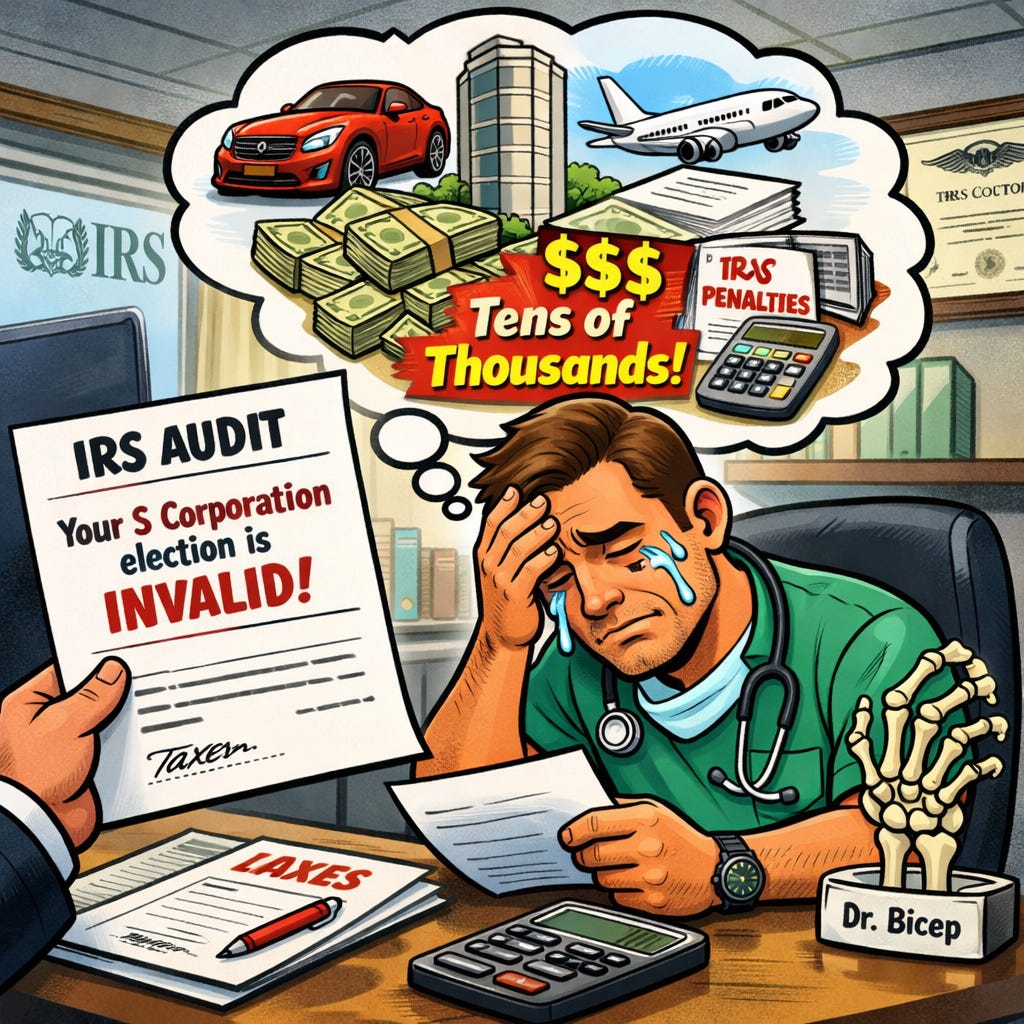
The IRS agent reviews his PLLC’s operating agreement.
And says:
“Your S corporation election is invalid.”
Mic drop.
Because up until this moment, Dr. Bicep believed he was operating as an S corporation.
He wasn’t.
Why This Is Devastating
An S corporation is a pass-through entity. Income flows through to the owner and is taxed once.
A C corporation is not.
It is taxed at the corporate level, and then again when profits are distributed.
That’s double taxation.
Now, Dr. Bicep is facing:
Corporate-level tax on his income
Dividend tax when he takes money out
Loss of the payroll tax advantages he expected from an S corp
All because of one document he never questioned.
What Actually Went Wrong
The rules for S corporation elections are governed by IRC §1361.
S status is not automatic. It’s conditional.
You only qualify if you meet every requirement.
One of the most misunderstood rules is this:
The corporation can only have one class of stock.
The Hidden Trap: One Class of Stock
This does not mean “only common stock” or “one certificate.”
Under IRC §1361(b)(1)(D) and Treas. Reg. §1.1361-1(l), it means:
All shareholders must have identical rights to distributions and liquidation proceeds.
In simple terms:
Ownership percentage must match economic rights.
If you own 30%, you receive 30%. Every time.
What AI Did
The operating agreement looked polished. Even sophisticated.
But it was written like a partnership agreement.
It included:
Special allocations of income and loss
Non-pro-rata (uneven) distributions
Different liquidation rights
These provisions are completely normal in partnerships.
But they are fatal for S corporations.
Because they create unequal economic rights.
And once that happens, you no longer have one class of stock.
Why This Kills Dr. Bicep’s S Election
Under IRC §1361(b)(1)(D), having more than one class of stock disqualifies the entity from being an S corporation.
There is no gray area here.
No “close enough.”
No “we’ll fix it later.”
If your governing document allows unequal economic rights, your S election is invalid.
In Dr. Bicep’s case, it was invalid from day one.
The Most Dangerous Part
Dr. Bicep didn’t do anything intentionally wrong.
He wasn’t hiding income.
He simply didn’t know.
AI gave him something that sounded correct - but it violated a core requirement of the tax code.
That’s the risk.
Can You Fix It?
Sometimes.
But it’s not easy.
You may qualify for relief under IRC §1362(f) if the IRS agrees the issue was inadvertent.
There are also limited streamlined fixes under Rev. Proc. 2022-19.
If those don’t apply, you’re left with requesting a Private Letter Ruling (PLR)
PLR typically means:
IRS user fee of $40,000+ (omg!)
Significant professional fees
No guarantee of approval
And if relief is denied, you may be stuck as a C corporation for years.
The Takeaway
AI is powerful.
But it may not fully understand your intent. And it definitely does not care about the consequences.
It generates language - not outcomes.
Final Thought
Use AI to draft.
But use a professional to verify.
Because one paragraph, just one, that violates IRC § 1361 can quietly destroy your S election and cost you six figures before you even realize it.