

“Doc, You Can ‘Step-Up’ Your House and Depreciate It?” — The $300,000 Tax Trap
Why a “smart” S corporation strategy can quietly turn your home sale into a six-figure tax mistake

Your tax strategist shares with you a brilliant idea.
You home has appreciated significantly, and you want to convert it into a rental.
Then your tax pro tells you:
“Sell it to your S corporation.
Lock in your $500k home gain exclusion under §121.
Step up the basis to fair market value.
Then depreciate it and create losses.”
It sounds elegant.
It sounds strategic.
It sounds like something only sophisticated investors do.
And that’s exactly what makes it dangerous.
This is the kind of strategy that makes high-income physicians feel like they’re finally “playing the game right.”
But in reality, this is one of the fastest ways to accidentally create a six-figure tax problem.
Meet Dr. Silicon Valley
Dr. Silicon Valley receives a home from his mother as a gift.
Fair market value: $3,000,000
Carryover basis from mom (who bought it years ago): $200,000
He and his wife, a realtor, live in the home as their primary residence for five years after receiving it. Now, they are ready to move and are considering converting the property into a rental.
His advisor recommends:
“Sell it to your newly formed S corp for $3 million.”
Lock in your $500k home gain exclusion under §121.
Step up the basis to $3M
Then rent it out, depreciate it and generate losses to offset your physician income since your wife is a real estate professional”
On paper, everything seems to line up.
Step 1 — The “Win” Everyone Focuses On
Let’s start with what’s actually correct.
When Dr. Silicon Valley sells the home:
Amount realized: $3M
Adjusted basis (carryover from mom): $200k
Realized gain: $2.8M
Assume he and his wife qualify for the full $500k home gain exclusion under §121,. That means:
§121 exclusion = $500,000
Remaining gain to recognize = $2.3M
Also,
The S corp’s purchase price, and therefore its starting cost basis, is $3M
Suppose $500K is allocated to land, which is non-depreciable, and $2.5M is allocated to the building, which is depreciable.
At this point, most people feel like they’ve already won.
You locked in the exclusion.
You stepped up the basis.
You’re about to generate losses from the building depreciation.
Everything looks perfect.
And then the tax code steps in.
Step 2 — The Rule That Quietly Turns This Against You: §1239
This is where the entire strategy starts to unravel.
IRC §1239 says:
If you sell property to a related party, and that property is depreciable in the buyer’s hands, the gain is not capital gain.
It becomes ordinary income.
Let that sink in.
You didn’t change the economics.
You didn’t make more money.
The tax code just changed the character of your gain.
And that single change is what creates the damage.
Now apply it here.
After your §121 exclusion, you still have about $2.3M of gain.
Most of that gain is tied to the building —which is depreciable inside the S corporation.
That means roughly $1.9M of your gain is now taxed as ordinary income.
Not at 20% capital gains rate.
But at 37% ordinary income rate.
That difference alone?
Over $300,000 in additional tax.
Not from a bad investment.
Not from market risk.
Just from how the gain is classified.
This is the kind of rule that almost never shows up in the “strategy pitch.”
Step 3 — The Transaction Must Be Real (Not Just a Paper Sale)
Even if you accept the §1239 related-party sale issue, there is still a bigger problem.
The IRS does not automatically respect this as a real sale just because you drafted documents and changed title.
To achieve the intended result from Step 1 (recognized gain, the use of §121, a new fair market value basis inside the S corp), the transaction must actually be a real sale.
It cannot be a disguised contribution or a circular paper transaction.
A key question from cases like Anschutz Co. v. Commissioner is whether there was a genuine transfer of the benefits and burdens of ownership.
In a bona fide sale:
The S corp must bear economic risk after the transaction
The note issued by the S corps must have real and commercial terms, including interest, enforceable payment obligations and meaningful economic substance.
There must be a genuine transfer of control to the S Corp
Dr. Sillicon Valley must actually give up benefits and burdens of ownership
If those factors are not present, the IRS can argue that this was never really a sale at all.
Instead, the IRS may say:
“This was simply a contribution of property to the S corp by Dr. Sillicon Valley”
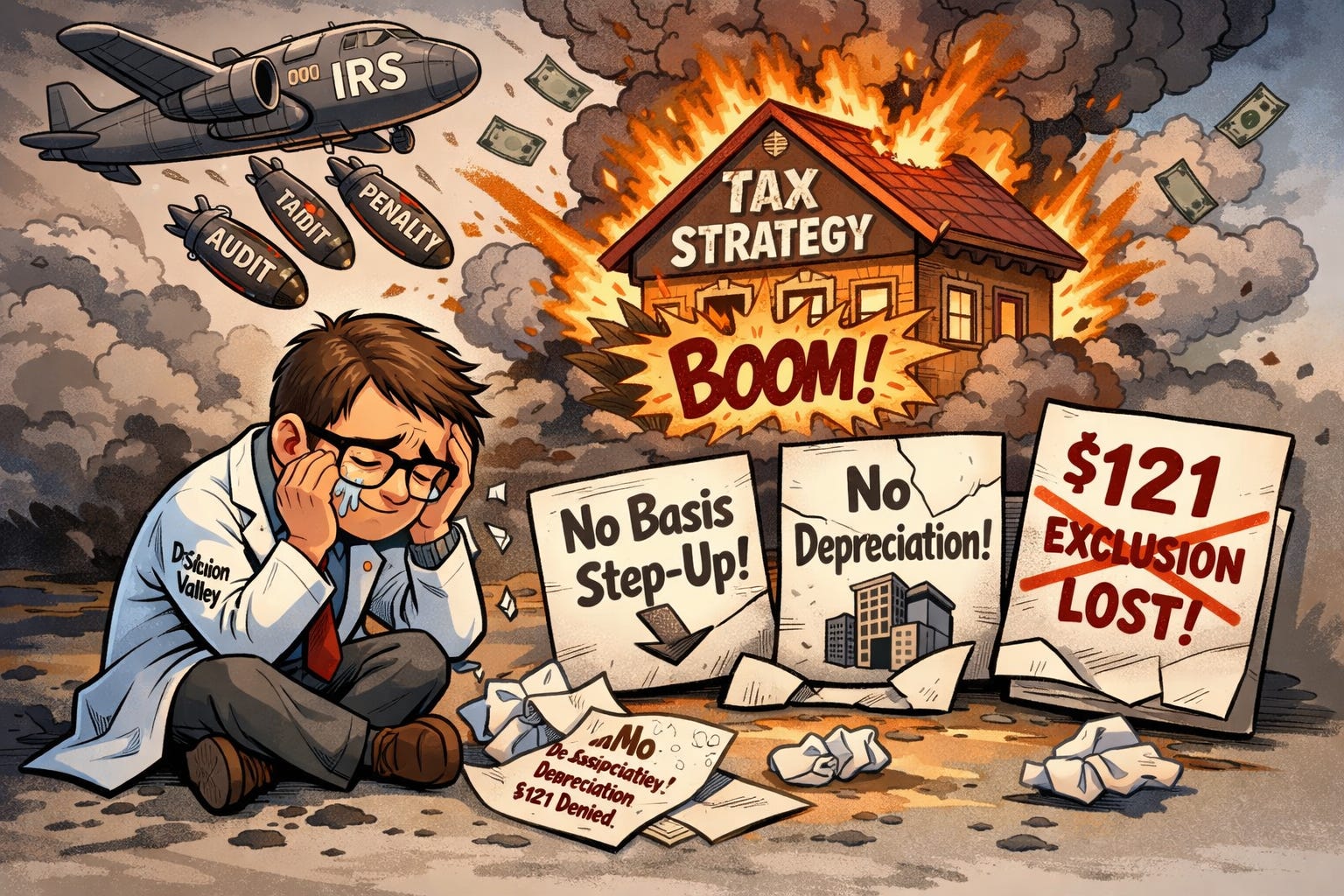
Step 4 — The Nightmare Scenario: It Was Never a Sale
Here’s where things go from bad to worse.
If the IRS determines this wasn’t a real sale…
Everything you thought you accomplished disappears.
No gain recognition.
No §121 exclusion.
No step-up in basis.
Instead, the IRS treats it as a contribution to your S corporation.
Now the property sits inside the S corp with a ~$200k carryover basis.
Your depreciation? Minimal.
Your “strategy”? Gone.
And the worst part?
You may have permanently given up one of the most valuable tax benefits in the entire code—§121—without getting anything meaningful in return.
And by the time you realize it…
It’s too late to fix.
Step 5 — The Mortgage Problem No One Talks About
Now let’s step outside the tax code.
Most homes have a mortgage.
And almost every mortgage contains a due-on-sale clause.
That means, if you transfer the property to your S corp:
The lender can demand immediate repayment of the full loan balance.
If that happens, you may be forced to:
Refinance (often at worse terms), or
Pay off the loan entirely
This is not some obscure technicality.
This is a real-world deal killer.
This isn’t a tax issue anymore.
This is your lender calling the loan, just like Dave Ramsey experienced in his investing career.
Step 6 — The “Workaround” That Creates Another Tax Problem
Some advisors try to work around the due-on-sales problem using a land trust and relying on the Garn–St. Germain Act.
The idea is to structure the transfer into a trust arrangement that does not trigger the due-on-sale clause which requires the shareholder to continue to occupy the property
But there’s a major catch:
If Dr. Silicon Valley continues to occupy the home, the property is still used as a residence.
That creates another tax problem.
At the S corporation level, IRC §280A is triggered. This provision can severely limit or even disallow deductions related to the property due to shareholder personal use.
So now:
You might have mitigated the mortgage due-on-sale risk,
But you’ve created a situation where the S corps’s “rental” deductions are heavily disallowed under §280A.
In other words, the “solution” to one problem creates a different problem.
Step 7 — Multi-Layer Complexity Most People Underestimate
This is not a DYI tax strategy.
This strategy touches multiple areas of law all at once:
§121, the home gain exclusion
§1239, which recharacterizes gain as ordinary income in related-party sales of depreciable property
§267, which supplies the related-party rules
§280A, which can disallow deductions when there is personal use of home.
Judicial doctrines such as bona fide sale, economic substance
Mortgage law, especially due-on-sale clauses
State transfer taxes, and legal fees, and title issues
Every layer has to work perfectly.
If even one fails, the entire structure collapses.
The Real Risk
You thought you were creating tax losses.
Instead, you may have:
Triggered six-figure ordinary income under §1239
Lost your $500k §121 exclusion
Destroyed your depreciation step-up
Locked the property inside an entity that can’t use §121
Created a refinancing problem you didn’t plan for
All from a strategy that was supposed to save taxes.
In Dr. Sillicon Valley’s case, the total damage can easily exceed $200,000–$300,000.
Final Thought
If someone presents this “sell your home to an S corp” strategy as:
“Simple”
“Common”
or “A great way to step up basis and create losses”
Pause.
Because this is exactly how costly mistakes start.
This strategy doesn’t fail because it’s aggressive.
It fails because it looks simple.
And when tax rules, legal structure, and real-world constraints all have to align perfectly…
“Almost right” isn’t close.
It’s a completely different outcome.
And in tax, that difference isn’t theoretical.
It shows up as a check you didn’t expect to write.