


Doctors - do you flip houses regularly?
Your flipped home is sitting on a cooler market.
Interest payments are piling up.
The house isn’t moving, and it’s starting to stress you out.
Then, a “brilliant” idea pops up in your head.
Installment sale!
“I’ll be the bank.”
No bank loan needed for the buyer.
Lower monthly payments for them (just charge the AFR).
Steady cash flow for you.
On the surface, it sounds perfect.
Why This Goes Wrong Fast from a Tax Perspective
Here’s the main tax problem.
If you are flipping houses, an installment sale usually does not work for tax purposes.
Why?
Because a flipped house is typically treated as inventory, not a capital asset.
And inventory is not eligible for installment sale reporting.
IRC §453(b)(2) and §453(l)(1)(B) specifically disallows the installment method for “property held for sale to customers in the ordinary course of business”—which is exactly what a flipped house is for the flippers.
What That Means in Plain English
Even if you sign an installment sale agreement and only receive part of the money this year, the IRS will treat you as if you received the full sales price upfront.
So, you could owe tax on money you haven’t actually collected yet.
That’s where things get painful!
A Painful Example:
You buy a beat-up property for $400,000.
You put in $300,000 of renovations.
Your total basis is $700,000.
You sell the property for $1,000,000.
Your profit is $300,000
Amazing!
Trap #1:
Because this is a flip, that $300,000 is ordinary income, not capital gain. This is because IRC §1221(a)(1) excludes “property held primarily for sale to customers in the ordinary course of business” from capital asset treatment.
Translation: that $300,000 is taxed just like your clinical income.
If you’re in the 37% bracket, that’s a 37% tax hit.
Ouch.
Trap #2:
Now the buyer says:
“I can’t pay $1,000,000 upfront. How about an installment sale?”
You agree.
This year, you only receive $100,000 in cash.
Here’s the problem.
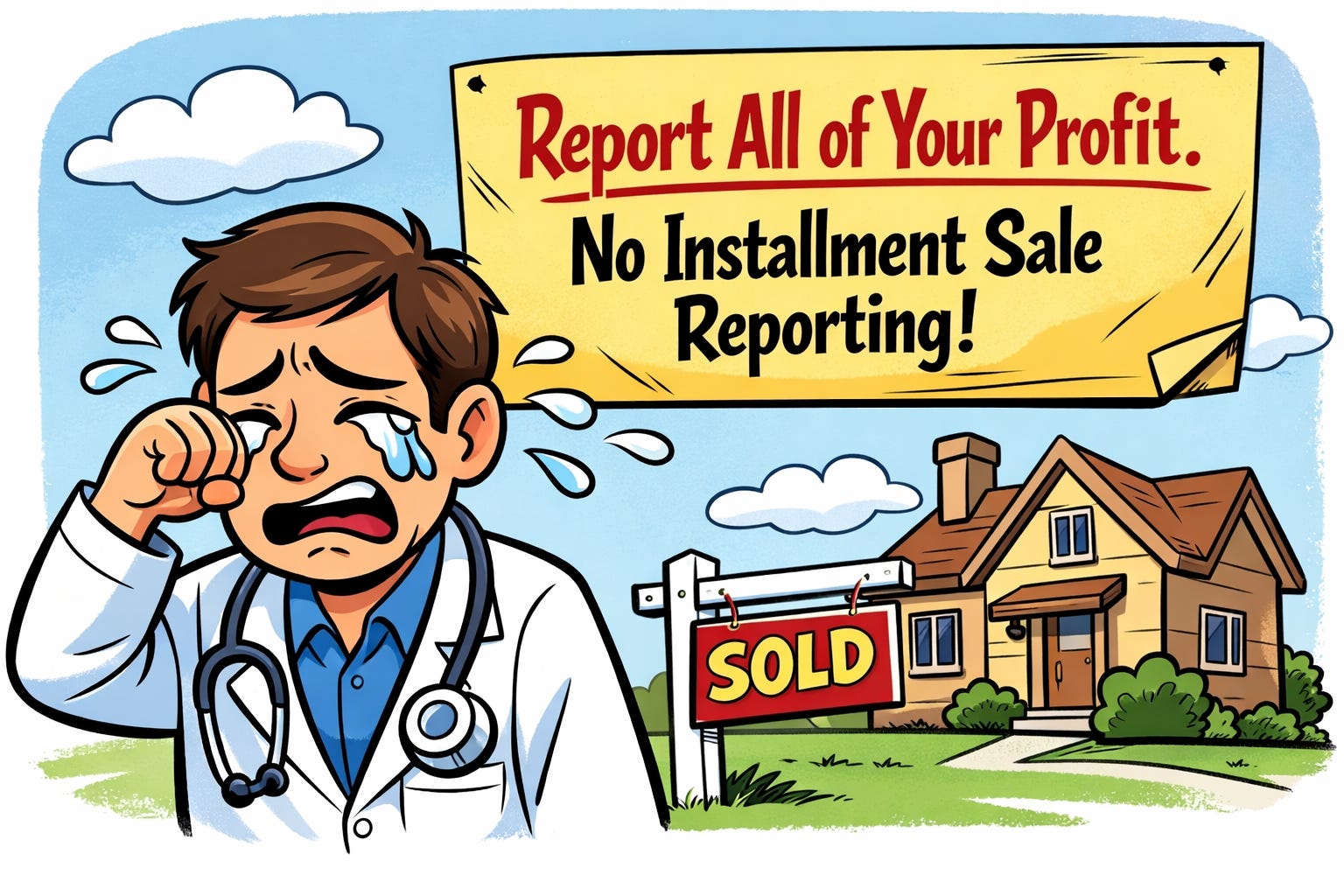
Because the house is inventory, you are not allowed to use installment sale reporting. You must report the entire $300,000 profit in the year of sale.
Even though you only received $100,000.
So now you may owe roughly $110,000 in tax while holding nothing but an IOU for the rest.
That’s how people get burned
!
The Bottom Line
If you are flipping houses, do not assume an installment sale will save you when the market slows down.
In many cases, it makes things worse.
Before agreeing to “be the bank,” you need to know whether the property is inventory or a capital asset.
One wrong assumption can leave you paying tax on money you haven’t collected yet.
This is one of those areas where real estate logic and tax logic are very different—and tax always wins.
Disclaimer: click here