


You’ve done a great job building a massive passive-income machine - like my real estate mentor - Dr. Hinh
So good, in fact, that even if you retired tomorrow, your tax bracket would still be 37%.
What a wonderful problem to have…
But… it does create a little bit of a tax problem.
When you contribute to a cash balance plan, you get a 37% tax deduction today (great!) - but when you retire, those dollars are taxed at 37% (not great!)
Tax-deductible now.
Taxable later.
A very typical tax-deferral strategy.
Wouldn’t it be nice to change the equation to:
Tax-deductible now AND tax-free later?
That’s where the magic of the 401(h) account comes in.
What Is a 401(h)?
This of a 401(h) as an HSA on massive steroids (almost cushingoid).
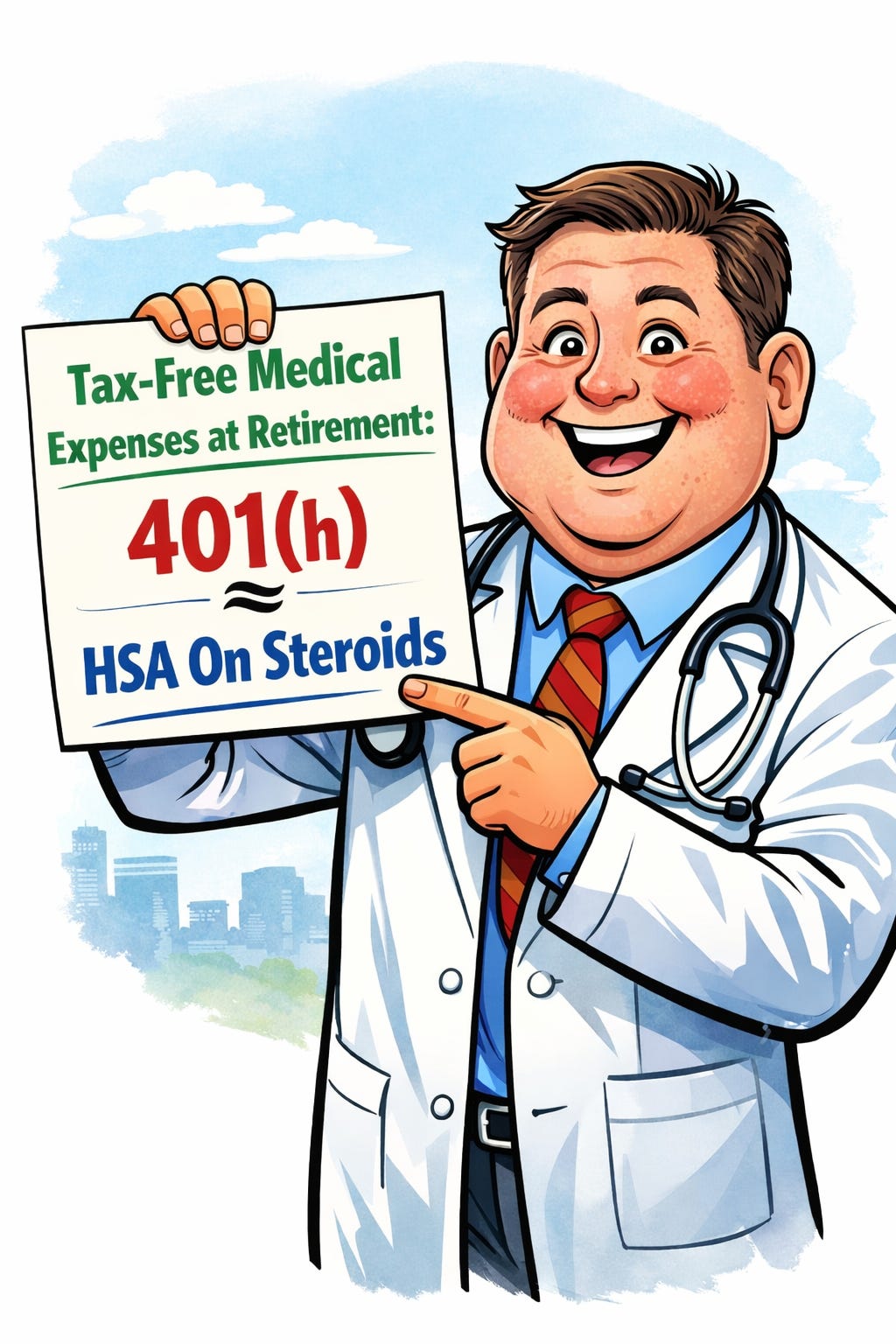
Instead of being limited to a mere $8,550 like an HSA, a 401(h) allows you to contribute much larger amounts.
It has similar DNA to an HSA, but with one key structural difference:
a 401(h) account is a special medical benefits account established inside a cash balance plan (or defined benefit plan).
Its purpose is simple:
to pay for medical, sickness, accident, and hospitalization expenses for retirees, their spouses, and dependents… tax -free!
Why High-Income Doctors Should Get Excited about it:
Here’s why this gets interesting at high income levels:
Contributions are tax-deductible now
Money grows tax-deferred inside the plan
Distributions (i.e., withdrawal) used for qualified medical expenses are tax-free at retirement
How It Fits Into a Your Cash Balance Plan
Here’s the key rule to understand:
A 401(h) does NOT increase how much you can contribute overall.
Instead, it allows you to earmark part of your cash balance plan contribution into a separate 401(h) medical benefits bucket.
There’s also a hard limit to keep in mind:
Medical benefits (plus any life insurance inside the plan) generally cannot exceed 25% of total plan contributions, excluding amounts for past service credits.
Same contribution.
Different buckets.
Very different tax outcomes later.
Why This Matters If You’ll Always Be in the Top Bracket
Let’s walk through a realistic scenario.
You’re 50 years old and single.
You’ve built a large rental and investment portfolio, generating $700,000 per year.
You’re firmly in the 37% tax bracket - and expect to stay there.
This year, you plan to contribute $150,000 to your cash balance plan.
Here’s the problem:
When you eventually take distributions from the pension portion, those dollars are taxed as ordinary income.
All at 37%.
The Fix:
Now you allocate 20% of that contribution to a 401(h).
That portion can be distributed tax-free - as long as it’s used for qualified medical expenses.
Same deduction going in.
Tax-free as the money comes out — a much better tax-outcome.
What Counts as Qualified Medical Expenses?
Qualified medical expenses generally include:
Health insurance premiums in retirement, including Medicare
Deductibles, copays, and prescriptions
Out-of-pocket medical expenses
Long-term care insurance premiums.
And yes — sometimes even a spa treatment, as long as it is medically necessary
Costs and Complexity (The Real Downside)
This is not a DIY strategy.
A 401(h) requires careful plan design and ongoing compliance.
You’ll need:
A cash balance plan drafted to include a 401(h)
An experienced third-party administrator
Annual actuarial certification
Ongoing compliance and recordkeeping
The costs are real and meaningful.
Setup fee: ~$10k
Annual administration: ~$5k
That’s why this strategy usually only makes sense when contributions are large.
For smaller contributions, the costs can easily outweigh the benefit.
Final Thoughts
If you are a high-income professional who:
Will likely remain in the top tax bracket
Maxes out a cash balance (or defined benefit plan)
Expects meaningful medical expenses in retirement
a 401(h) account can be an extremely efficient tax-planning tool.
It doesn’t let you contribute more - it just lets you change how much of your retirement dollars can be tax-free when distributed.
For the right person, the tax savings can be huge.
This is advanced plan-design territory—but for some late-career professionals, it’s absolutely worth a closer look.
Disclaimer: click here