

The $1M "Tax Deduction” That Keeps Getting Doctors in Trouble
It works on paper. It fails in court.

A surgeon making $2M+ and paying close to $1M in taxes hears this:
“Set up a micro-captive. Have your practice pay $1M. Deduct $1M. Pay almost no tax on the other side.”
Left “practice” pocket → right “micro-captive” pocket
≈ $500K tax savings at a 50% rate
“I can buy an apartment complex with this… every year.”
Feels like free money.
Feels like a fast track to FIRE.
Unfortunately, it’s not.
A Real-World Scenario: How Doctors Get Pulled In
Dr. Nip Tuck owns a Beverly Hills cosmetic practice generating $2M of net income.
He’s told:
Pay $1M in premiums from your practice
Deduct under IRC §162
Send the $1M to an insurance company you own
Elect IRC §831(b) → avoid tax on premium income
Even better, the money gets invested and grows inside the captive.
Sounds very tax efficient.
But from the IRS’s perspective, everything comes down to one question:
Is this actually insurance… or just a tax structure?
The Micro-Captive Structure Legit?
Yes - but only if it meets strict requirements.
IRC §831(b) allows it.
The courts decide whether it’s real.
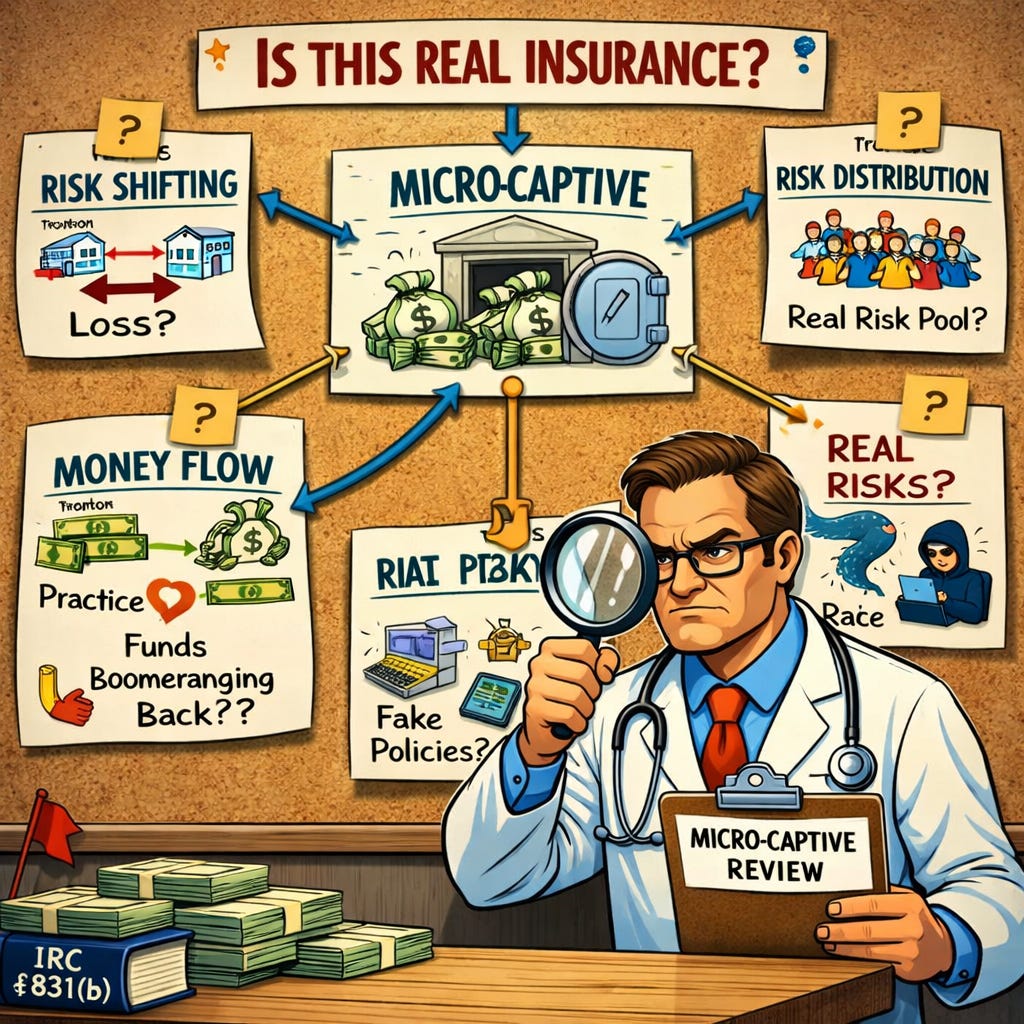
The Four Requirements of “Real Insurance” (Where Deals Fail)
#1: Risk Shifting — Did the Risk Actually Leave Your Practice?
Risk shifting means the financial burden of a loss moves from your practice to the insurance company.
For risk shifting to exist, one simple question must be answered:
If a real claim happens, who actually takes the loss?
In a valid structure:
The insurer pays the claim
The insurer’s assets decrease
The loss stays with the insurer
Risk shifting fails when, in substance:
You control both the practice and the captive
The captive does not have the financial capacity to pay a meaningful claim
Your practice would ultimately step in and absorb the loss
So, if a large claim would come back to your practice…
then the risk never truly left your practice.
No risk shifting → no insurance.
#2: Risk Distribution — Is The Risk Spread Across a Real Pool or Just a Fake Pool?
Risk distribution spreads risk across many independent participants so that no single loss drives the outcome. This is what makes insurance predictable over time.
For risk distribution to exist, one simple question must be answered:
Are you actually sharing risk with others—or just recycling your own risk?
In a valid structure:
There are many unrelated insureds participating
The risks are independent (different specialties, locations, operations)
Losses are absorbed across the group over time
Risk distribution fails when, in substance:
The risk is mostly your own
The “pool” does not meaningfully transfer losses between participants
Premiums do not change based on actual loss experience
In Avrahami v. Commissioner, the court found exactly that:
The pool existed in form—but did not alter the economics of the risk.
So, if the risk stays within your own controlled group…
then there is no real risk distribution.
No risk distribution → no insurance.
#3: Real Insurance Behavior — Or Just Money Moving Around?
Real insurance requires that premiums leave your practice, stay with the insurer, and are used to pay claims.
For real insurance behavior to exist, one simple question must be answered:
Did the money actually leave your control—and stay gone?
In a valid structure:
Premium leaves your practice
The insurer controls the funds
The funds are used to pay legitimate claims
Real insurance behavior fails when, in substance:
Money leaves your practice but returns through loans or investments
You retain control over the funds through related entities
Claims are not handled in an independent, insurance-like manner
This commonly shows up in three ways:
#1: Circular cash flow
Practice pays $1M
Captive receives $1M
Captive loans or invests money back to you
The money comes back like a boomerang.
You deducted it—but still control it.
No real economic change occurred.
In Syzygy Insurance Co. v. Commissioner, the court saw exactly this and rejected the structure.
#2: The loan problem
Captive loans money back to the practice
The practice make investments into related entities
The IRS strongly disfavors this because:
→ The money never truly leaves your control
#3: Actuarial premium failure
Premiums must be based on real risk—not tax limits.
The §831(b) limit is the maximum premium a micro-captive can receive (currently $2.2M annually) while being taxed only on investment income.
Example:
$1M premium
$90K investment income
Only $90K is taxed
Red flags:
Premium equals the §831(b) limit every year
No adjustment for claims
No independent actuarial support
So, if the money comes back to you…
or the premium is driven by tax limits rather than risk…
then the arrangement is not functioning like real insurance.
No real insurance behavior → no insurance.
#4: Are the Risks Real? — Or Just Written to Justify a Deduction?
Insurance only works if the risk being insured is real.
For real insurance to exist, one simple question must be answered:
Is this a risk that a real insurer would actually insure?
In a valid structure:
The risk is common and plausible (e.g., business interruption, cyber risk, regulatory exposure)
The risk has a clear financial impact if it occurs
The risk resembles something a real insurer would evaluate and price
The structure fails when, in substance:
The risks are extremely unlikely or remote
The policies are custom-designed with no real-world equivalent
There is little to no claims history over time
In Avrahami v. Commissioner, the court saw exactly this:
A small jewelry store in Arizona insured terrorism risk
The coverage did not resemble real-world insurance
The court asked:
Would a real insurer write this policy at this price?
The answer was no.
So, if the risks feel artificial…
or exist mainly to justify the premium…
then the arrangement is not insuring real risk.
No real risk → no insurance.
The New IRS Playbook (2025 and Beyond)
As of January 14, 2025, microcaptives may be classified as:
Listed Transactions
Transactions of Interest
Both signal IRS scrutiny and requires disclosure.
Two key factors determine classification.
#1: The financing factor (aka, loan factor):
Practice pays $1M
Captive loans $800K back
This is the type of structure the IRS is concerned about. The captive’s capital is being made available to the owner or related parties, rather than functioning like true insurance capital.
#2: The loss ratio factor:
Loss ratio = Claims ÷ Premiums
Example:
$10M premiums
$500K claims
5% loss ratio
Low ratios suggest accumulation—not insurance.
General thresholds:
Less than 30% → listed transaction risk
Less than 60% → transaction of interest
So, if money flows back to you…
or claims remain low relative to premiums…
then the structure may trigger reporting requirements.
Failure to disclose → penalties.
IRS Have Been on a Winning Streak since 2017
Since losing Rent-A-Center Inc. v. Commissioner in 2014, the IRS has consistently won on the substance of micro-captive insurance structures.
Avrahami (2017):
Fake pooling → failed risk distribution
Not insurance in the commonly accepted sense
Reserve Mechanical (2018):
No real risk transfer → failed risk shifting
Syzygy (2019):
Circular cash + arbitrary premiums → failed across the board
Caylor (2021) and Swift (2024) followed the same pattern.
What This Actually Means for Doctors
The IRS is not focused on your structure.
They’re focused on your economics.
If money leaves your practice—but you still control it—that’s the problem.
And equally important:
Are the risks real?
Are the premiums real?
The Bottom Line
There are many promoters in this space.
Most physicians should stay away—especially if:
The pitch starts with tax savings
Premium conveniently hits the cap
Risks feel fabricated
The pool feels artificial
Some structures can work—but only when:
Real risks exist
Real insurance behavior exists
Why This Matters Beyond Microcaptives
This is how the IRS evaluates everything:
Substance over structure
Reality over paperwork
If you understand this, you’ll stop falling for “too perfect” strategies.
My experience reviewing many strategies:
If something sounds too good to be true—it usually is.
Get a Real Second Opinion
If you’re in a micro-captive—or any strategy that sounds “too perfect”—have it evaluated the way the IRS will.
Book a consult.
I don’t sell strategies.
I stress-test them.
