


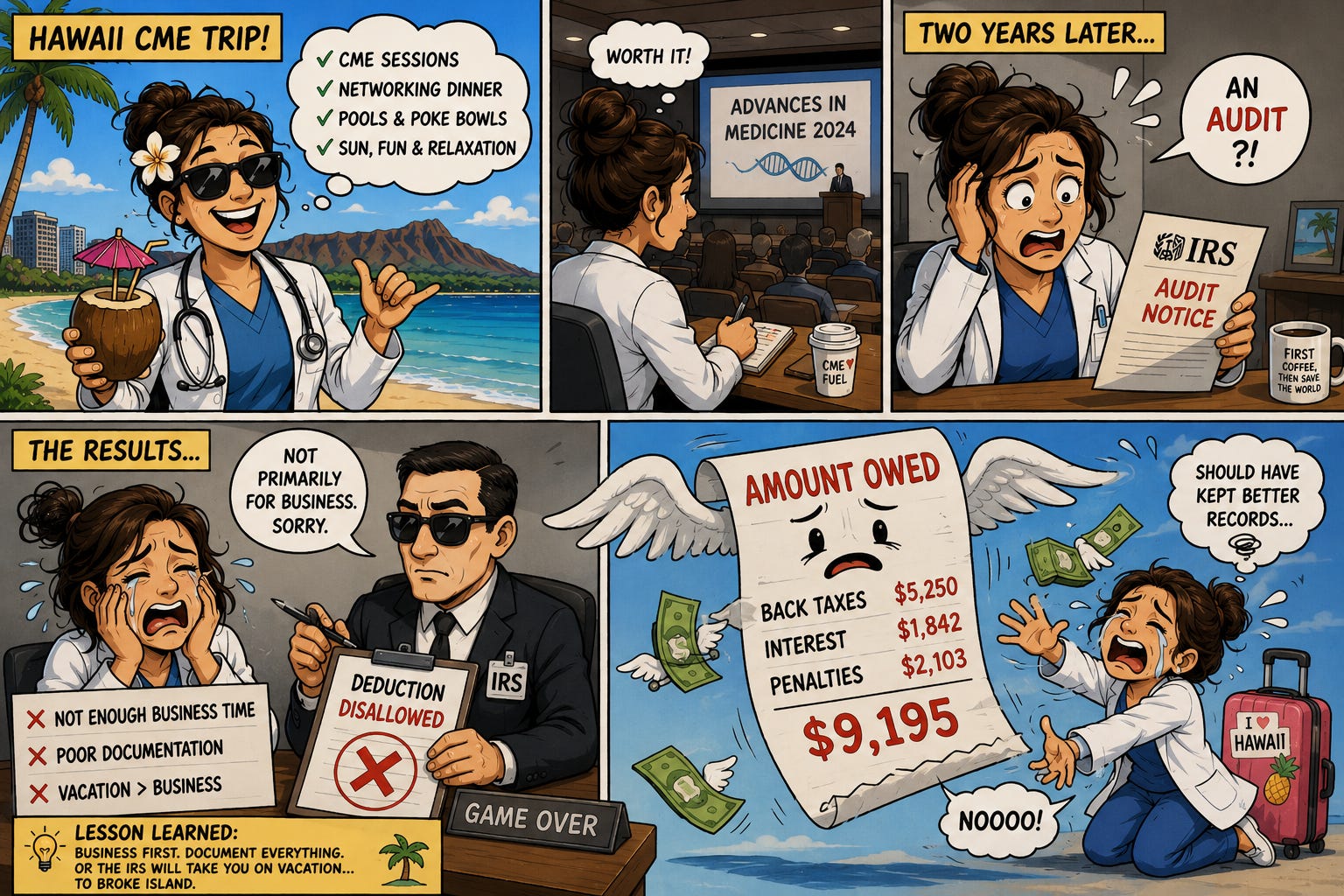
Dr. Smart flies to Hawaii for a four-day medical conference.
Two CME sessions on day one.
Pools and poke bowls for the next two days.
One networking dinner on day four.
Then she flies home and writes off the entire trip.
Two years later?
IRS audit.
Entire deduction denied.
And this keeps happening to physicians.
Here’s why — and how to avoid it.
Why Physicians Get Scrutinized
High-income professionals face higher audit risk.
And physicians are uniquely exposed because your profession naturally involves:
Medical conferences
Speaking engagements
Research trips
Destination conferences
Most of these trips are legitimate.
But from the IRS’s perspective, there’s one problem:
The line between “continuing medical education” and “vacation with a CME badge” can get blurry very quickly.
And travel deductions are one of the first places auditors look.
The Standard: “Primarily for Business”
This is where many physicians get into trouble.
The rule is not:
“Did business happen during the trip?”
The actual standard under Reg. §1.162-2(b) is much stricter:
Was the trip primarily for business?
The IRS and courts generally evaluate three things:
1. Time Allocation
How much of the trip was actually spent on legitimate business activity?
Two conference hours and three beach days is not a great ratio.
2. Substance
Was the activity directly connected to your medical practice or business?
3. Personal Component
Was leisure incidental…
or was the destination itself the real reason for the trip?
The regulations are surprisingly direct on this.
One week of business and five weeks of vacation?
Primarily personal trip.
That’s not opinion.
That’s literally Reg. §1.162-2(b)(2).
And there’s another issue physicians often overlook:
Location matters — especially for international trips.
If all participants are U.S.-based physicians…
your practice is in California…
your hospital is in Texas…
but the “business meeting” is suddenly in Costa Rica…
the IRS asks one question:
“Why Costa Rica?”
If the same meeting reasonably could have happened in St. Louis, you may have a problem.
Three Things That Commonly Destroy Otherwise Valid Deductions
#1 — Poor Documentation (IRC §274(d))
This is probably the biggest one.
Physicians understand charting.
The IRS thinks the exact same way.
If it wasn’t documented properly…
it didn’t happen.
IRC §274(d) requires contemporaneous documentation of:
Amount
Time and place
Business purpose
Business relationship
And here’s the dangerous part:
The Cohan rule does NOT apply to travel deductions.
Normally, courts can estimate expenses when records are imperfect.
Not here.
Bad records can mean the entire deduction gets denied.
In Mitchell v. Commissioner (T.C. 2023), over $11,000 of travel deductions were denied because the mileage logs and hotel records contradicted each other.
Almost every dollar was disallowed.
Keep a simple travel log.
Think of it like a SOAP note for your trip:
Date
Location
Who you met
Business purpose
What was discussed
Five minutes of documentation can save thousands later.
#2 — Spouse and Family Travel (IRC §274(m)(3))
This is another major trap.
Your spouse attending dinner…
helping with logistics…
taking notes…
being “supportive”…
is usually not enough.
To deduct spouse travel, the spouse generally must:
Be a legitimate W-2 employee
Have a genuine business role
Need to be physically present for business purposes
Independently satisfy all travel deduction rules
Courts routinely deny these deductions even when the spouse technically works in the business.
Titles alone don’t matter.
Economic substance does.
#3 — International Travel Rules (IRC §274(c) and §274(h))
International conferences trigger additional rules.
Even if the trip is primarily business…
if more than 25% of the trip is personal, or if the trip lasts more than 7 days, part of the deduction may be disallowed.
Example:
10-day international trip
4 personal days
Potentially 40% nondeductible on certain items.
And foreign conventions face another hurdle:
You may need to demonstrate why the conference reasonably needed to occur outside the United States.
If all attendees are U.S.-based physicians…
and the same meeting could have occurred domestically…
that becomes difficult to defend during an audit.
The Bottom Line
The IRS evaluates facts.
Not intentions.
What survives an audit:
Business as the dominant purpose
Reasonable business location (especially for international trips)
Contemporaneous documentation
Understanding spouse and international travel rules before booking the trip
Travel deductions are absolutely legitimate.
But the legal standard is much stricter than what many physicians hear online.
Especially when the destination happens to have beaches, golf courses, and infinity pools.
Are you a physician or dentist looking for legitimate ways to reduce your taxes?
Book a free consult:
https://linktr.ee/drtaxtor


