

The S-Corp Vasectomy
Easy going in. Painful (and expensive) to reverse when it’s time to get your building out

You’re a dentist.
A smart one.
You own:
A professional corporation (or PLLC) for your dental practice
An LLC for your dental building.
Clean. Logical. Standard.
Then someone says:
“Hey… elect S-corp for the building too. Save on taxes.”
And you think:
“Of course. S-corp is always better.”
Pause.
This is where even very sophisticated dentists — and their advisors — get it wrong.
The Rule Most People Forget
When it comes to real estate, the default is usually:
Disregarded entity (single-member LLC), or
Partnership (multi-member LLC)
Not S-corporation.
Why?
Because real estate is not just about saving tax today.
It’s about flexibility tomorrow.
And S-corps quietly destroy that flexibility.
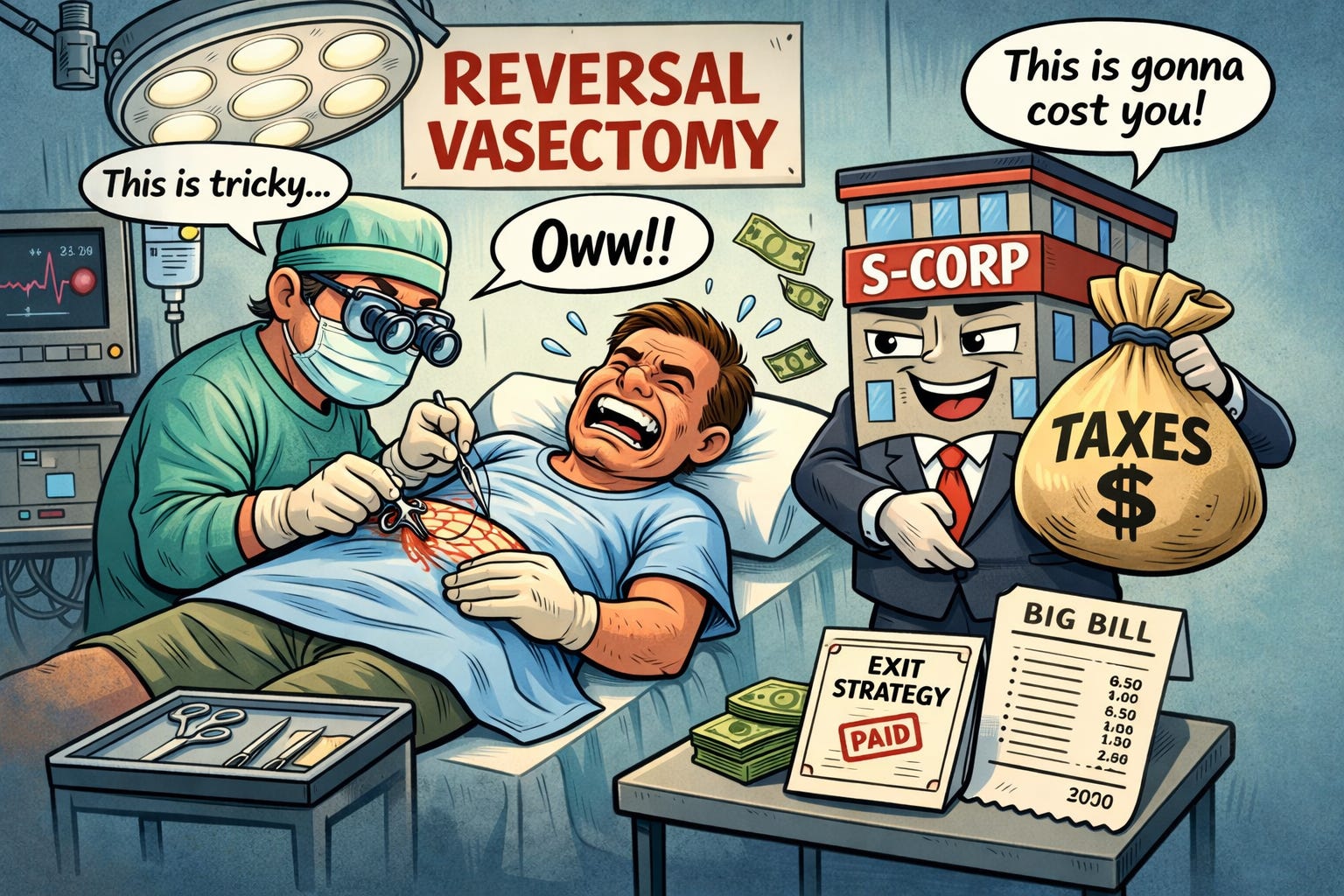
The Vasectomy Analogy
Electing S-corp for real estate is like a vasectomy.
Seems simple.
Sounds efficient.
But reversing it later?
Painful. Costly. Sometimes not feasible.
What Actually Changes with a S election
Before:
“I own the building.”
After:
“My S-corp owns the building.”
That sounds subtle.
It’s not.
Because once you make the S election, you’ve stepped into corporate tax rules — Subchapter S.
And those rules are unforgiving when you try to move that property later.
The Trap: Getting the Building OUT
Meet Dr. Crown.
Bought building: $500K
Value today: $2.5M
He’s retiring and wants to:
Move it into a trust
Transfer to another entity
Or just hold it personally
All reasonable.
But here’s the problem:
He can’t take it out without triggering tax.
The Tax Bomb — IRC §311(b)
If an S-corp distributes appreciated property like his dental building:
The IRS treats it as if the corporation SOLD the property at fair market value.
What???
Even if:
No cash changes hands
You still own 100%
Nothing economically changed
Tax law says:
“Sale.”
Result:
Gain = $2.5M – $500k = $2M
That gain flows to you under IRC §1366
You pay tax on $2M
Just to move your own building.
That’s the trap.
“I’ll just Hold It Until Death” Strategy
Great instinct.
Under IRC §1014:
Assets get stepped up to fair market value at death
Built-in gain disappears
This is one of the most tax-payer friendly rules in the entire Code.
But inside an S-corp
It breaks.
The Hidden Problem at Death
At death:
Your S Corp stock gets a step-up
The building inside the S-corp does NOT
So If Dr. Crown’s heirs sell the dental building:
Gain is still based on $500k basis
Same $2M gain shows up
If they try to distribute it?
→ IRC §311(b) kicks in
→ The distribution is treated as a sale
→ Same tax hit
The gain isn’t eliminated.
It is trapped.
Why Partnerships Win
Most real estate uses partnerships for one big reason:
Flexibility.
With a partnership:
You can often take cash or property out without triggering tax
With an S-corp:
Taking property out can trigger a taxable “sale”
That’s the difference.
One gives you flexibility.
The other can create a tax bill just for moving your own asset.
When it comes to real estate:
Partnerships win.
When an S-corp Might Still be Okay
There are limited cases:
Short-term hold (you plan to sell soon anyway)
Minimal appreciation expected
You’re already stuck in it and unwinding is worse
But notice the pattern:
These are exceptions.
Not the strategy.
The Clean Structure
For most dentists:
Practice:
Professional Corporation or Professional LLC
Taxed as S-corp (for income planning)
Building:
LLC
Taxed as a disregarded entity (single owner) or partnership (multiple owners)
Why this works:
Income planning → S-corp
Asset flexibility → LLC
Separate. Optimized. Intentional.
Final Thought
S-corps are powerful.
But not universal.
For operating businesses?
Often great.
For appreciating real estate?
They can create a major tax trap.
And I’ve seen that mistake cost:
Hundreds of thousands in unnecessary tax.
All from one election…
That sounded like a “no-brainer.”